Components & the Codex
A component is a device tag in this project. It points at a Codex part: manufacturer, part number, category, description and a list of terminals. Several components can share one part. The example’s three shutdown buttons S2, S3 and S4 are all the same 40mm 1NC button, and F1–F3 are the same blade fuse holder.
- Change which part a tag uses on the Components tab. Edit parts, terminals, manufacturers and logos in the Codex.
- Right-click a block on the canvas and choose Duplicate to add another component with the same part and the next free tag (
S4→S5). The copy has no wires. - Hover a block’s header to see its tag, part name, manufacturer and part number. Hover a terminal to see its name, connection type, signal and whether it’s wired.
Parts are only created and edited in the Codex, and they must be complete before they save: name, manufacturer, part number, category, description, and at least one terminal with a name, connection type and default signal. That rule keeps every drawing and BOM line meaningful.
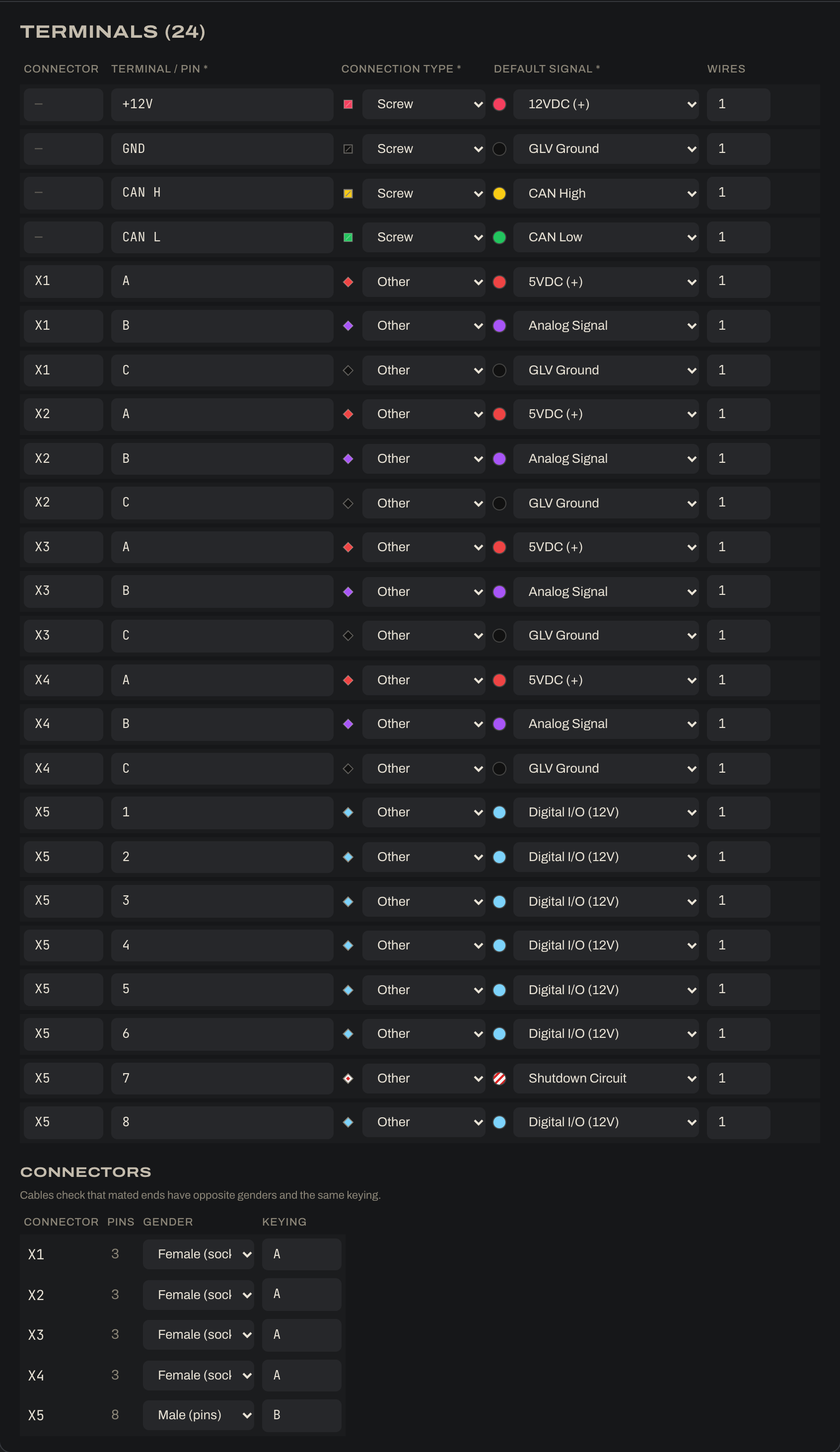
- Connector column: give terminals the same connector name (
X1) to group them into a multi-pin connector. Pin names only need to be unique within their connector, so the VCU’s four sensor ports can all have pins A, B and C. Add terminal after a pin continues the same connector with the next pin. - Each connector records its gender (male pins or female sockets) and keying. The VCU’s sensor ports are female, keying A, to mate with the sensors’ male plugs. The rear harness X5 is male, keying B, so it can’t be plugged into a sensor port by mistake.
- Each terminal sets how many wires it accepts (Wires, e.g. 2 for a two-level terminal). Leave it at 1 and Ohmstead will route fan-outs through terminal strips.
Free plan: everything you add to the Codex is public. Pro and Student: new parts and signal types are private until you publish them. Built-in parts are read-only; fork one to change it.